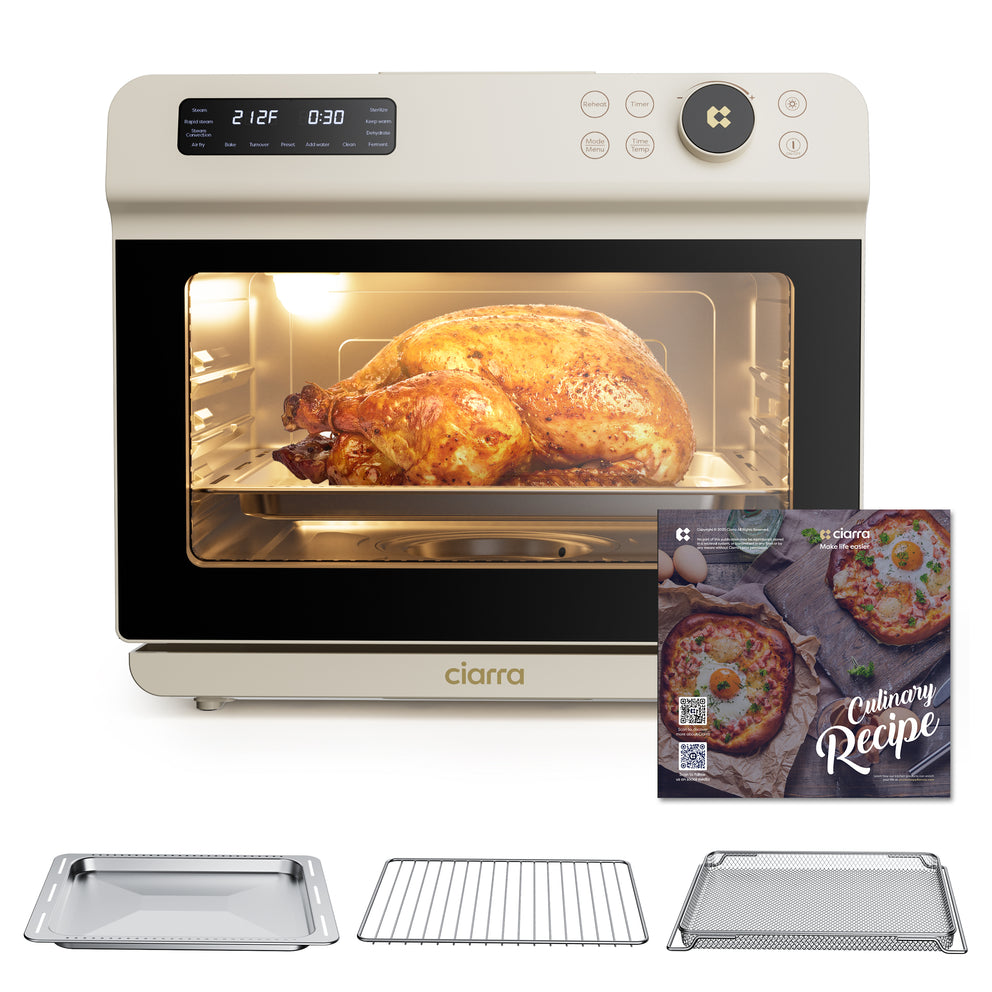









Short on time? A convection oven like the Ciarra Nosh Pro (Convection Oven) cooks 25% faster and delivers much crispier results than traditional ovens.
What is a Convection Oven?
A convection oven is a type of oven that uses a fan and an exhaust system to circulate hot air around food while cooking. This constant circulation ensures even heat distribution and can lead to faster cooking times and more consistent results compared to traditional cooking methods. Convection ovens can be used for baking, roasting, and even dehydrating food. They are available in both countertop and built-in models and have become increasingly popular due to their ability to deliver professional-level results in the home kitchen.
How Does a Convection Work?
Convection ovens operate differently from traditional ovens because they use a fan and exhaust system to circulate hot air around the food. This forced air helps to remove the cooler air surrounding the food, allowing the food to cook more quickly and evenly.
Here’s a basic breakdown of how a convection oven works:
- The oven's heating elements generate heat.
- The fan circulates the hot air throughout the oven cavity, creating an even temperature.
- This circulating air helps food cook more uniformly and can achieve better browning and crispiness.
- Convection ovens may have additional features such as multiple fan speeds, adjustable temperatures, and different cooking modes, allowing for more precise control over the cooking process.

Do Convection Ovens Cook Faster?
Yes, convection ovens typically cook faster than conventional ovens. The reason for this is the constant circulation of hot air, which allows heat to reach the food more efficiently. In a conventional oven, heat is absorbed slowly by the food from the heating elements, which can take longer to cook. In a convection oven, the circulating air helps to speed up the process.
As a general rule, you can expect cooking times to be reduced by about 25% when using a convection oven compared to a conventional oven. This makes convection ovens especially useful for busy cooks who want faster results without sacrificing quality.
How Long to Cook a Turkey in the Oven?
When roasting a turkey, cooking time can vary depending on the type of oven used.
In a conventional oven, you would typically roast a turkey for about 15 minutes per pound at 325°F (165°C).
In a convection oven, the cooking time can be reduced by about 25%. For example, a 12-pound turkey that would take approximately 3 hours in a conventional oven will take around 2 hours and 15 minutes in a convection oven.
It’s essential to use a meat thermometer to ensure the turkey reaches an internal temperature of 165°F (74°C) to guarantee it’s properly cooked.

What is the Conventional Oven?
A conventional oven is a type of oven that uses two stationary heating elements to generate heat: one at the top and one at the bottom of the oven cavity. The bottom element is primarily responsible for heating the oven and is commonly used for roasting, baking, or cooking large cuts of meat, such as turkey or whole chickens. The top element, on the other hand, is used for broiling and browning dishes, such as casseroles, where intense top-down heat helps achieve a crispy, golden finish.
Unlike convection ovens, conventional ovens lack a built-in fan to circulate hot air. This means that heat inside the oven rises naturally and may create uneven heat distribution, leading to hot and cold spots. As a result, rack placement becomes particularly important in a conventional oven. To ensure even cooking, you may need to rotate dishes, especially when baking or roasting.
Key Features of a Conventional Oven:
- Two Heating Elements: One at the bottom (for roasting and baking) and one at the top (for broiling and browning).
- No Fan: Heat is distributed naturally, without air circulation, leading to potential hot spots inside the oven.
- Versatility: Great for a wide range of cooking tasks, including baking, roasting, and broiling.
Convection Oven vs Conventional Oven
| Feature | Convection Oven | Conventional Oven |
|---|---|---|
| Heating Method | Fan-assisted circulation of heat. | Top and bottom heating elements with natural heat distribution. |
| Cooking Speed | Cooks food faster due to even heat circulation. | Takes longer, as heat distribution is slower and less even. |
| Heat Distribution | Even heat across all racks. | Uneven heat, which can cause hot and cold spots. |
| Best Uses | Great for baking, roasting, and multi-dish cooking. | Ideal for simple roasting and baking, especially casseroles. |
| Energy Efficiency | More energy-efficient because of shorter cooking times. | Less efficient, as it takes longer to cook. |
Convection vs Conventional Oven: Efficiency
Efficiency refers to how quickly and effectively an oven uses energy to cook food. Convection ovens are generally more energy-efficient than conventional ovens.
This is due to their faster cooking times and the efficient circulation of heat. Because convection ovens cook food more quickly, they often consume less energy. This can result in lower energy bills over time.
Conventional ovens, on the other hand, use more energy due to longer cooking times and less efficient heat distribution. While they are still effective for most cooking tasks, they do not offer the same level of energy efficiency as convection ovens.
Convection Oven vs Conventional Oven: Cooking Times
Convection ovens are ideal for reducing cooking times. For example:
- Roast chicken: 45-60 minutes in a conventional oven vs. 30-40 minutes in a convection oven.
- Cookies: 12-15 minutes in a conventional oven vs. 9-12 minutes in a convection oven.
In contrast, conventional ovens take longer to cook food because of slower heat distribution. For dishes like roasted vegetables, conventional ovens may require an additional 10-15 minutes.
Convection vs Conventional Oven: Cooking Times Chart
| Food Item | Conventional Oven Time | Convection Oven Time |
|---|---|---|
| Roast Chicken (4 lbs) | 1.5 hours | 1 hour |
| Turkey (12 lbs) | 3 hours | 2 hours 15 minutes |
| Cookies | 12-15 minutes | 9-12 minutes |
| Roasted Vegetables | 45 minutes | 30-35 minutes |
| Baked Potatoes | 60 minutes | 45 minutes |
Convection Oven vs Conventional Oven: Temperatures
When using a convection oven, it’s recommended to reduce the temperature by about 25°F (14°C) compared to the temperature stated in a conventional oven recipe. For instance, if a recipe calls for cooking at 350°F in a conventional oven, set your convection oven to 325°F.
This temperature reduction accounts for the more efficient heat circulation in a convection oven, ensuring that the food doesn’t get overcooked or dry out.
Convection Oven vs Conventional Oven: Pros and Cons
Pros of a Convection Oven
1. Faster Cooking Time:
The fan circulates hot air, cooking food faster than in a conventional oven, saving you time on busy nights.
2. Better for Multi-Rack Cooking:
Even heat distribution allows you to cook multiple dishes at once without uneven results, eliminating the need to rotate trays.
3. Promotes Browning and Crisping:
Convection ovens excel at browning and crisping, creating a golden, crispy finish on roasted meats, vegetables, and baked goods.
4. Even Heating:
The fan ensures uniform heat, reducing hot spots for more consistent cooking.
5. Quick Preheating:
Convection ovens heat up faster than conventional ovens, allowing you to start cooking sooner.
6. Long Baking Cycles Without Drying Out Foods:
The circulating air helps retain moisture, ideal for slow-roasting meats or baking bread.
7. Versatility:
Many convection ovens offer traditional oven modes and convection settings, giving you flexibility for various cooking needs.
Cons of a Convection Oven:
1. Learning Curve:
Cooking with a convection oven may require some adjustments to traditional recipes. You typically need to lower the cooking temperature by about 25°F and reduce cooking times. This can take some trial and error to perfect your recipes.
2. Fan Noise:
The circulating fan that powers convection cooking can be noisy. For some users, this noise may be distracting, especially when the oven is running for long periods of time.
3. Cost:
Convection ovens are typically more expensive than conventional ovens, especially models with advanced features. If you're on a tight budget, this can be a deciding factor.
4. May Not Be Ideal for All Dishes:
Certain delicate dishes, such as soufflés or cakes, may not perform as well in a convection oven. The constant air circulation can disrupt the delicate rise or texture of some baked goods, resulting in uneven or undesirable outcomes.
Pros of a Conventional Oven:
1. Familiar Functionality:
Easy to use and familiar, making it ideal for everyday cooking with traditional recipes.
2. No Need for Adjustments:
No need to change temperatures or cooking times; just follow the recipe as is.
3. Variety of Cooking Modes:
Offers modes like bake, broil, and roast, making it versatile for different cooking styles.
4. Cost-Effective:
Generally more affordable than convection ovens, perfect for those on a budget.
5. More Even for Certain Dishes:
The lack of air circulation can benefit delicate dishes that require gentle, consistent heat.
Cons of a Conventional Oven:
1. Longer Cooking Times:
Takes longer to cook due to uneven heat, requiring dish rotation for even results.
2. Uneven Heat Distribution:
Without a fan, hot spots can cause uneven cooking, needing manual adjustments.
3. Energy Inefficiency:
Longer cooking times lead to higher energy usage and higher utility bills.
4. Limited Crisping and Roasting:
Struggles with achieving the same browning and crisping as convection ovens.
Best Convection Oven: Ciarra Nosh Oven
When it comes to versatile, high-performance convection ovens, Ciarra offers two standout models—the Ciarra Nosh Oven Pro and the Ciarra Nosh Oven. These countertop ovens are not only designed to meet the needs of busy families, health-conscious individuals, and home chefs alike, but they also incorporate convection cooking technology for faster, more even results. Unlike traditional ovens, convection ovens use a fan to circulate hot air, ensuring that your food cooks evenly and quickly, with a crispy outside and tender inside. Both models feature advanced cooking capabilities like steaming, air frying, and baking, but they differ in size, wattage, and functions. Whether you're looking to save time in the kitchen or cook healthier meals, these convection ovens offer innovative features to elevate your cooking experience.
Why Choose Ciarra Nosh?
Think convection ovens are noisy or complicated? Think again. Ciarra has re-engineered the experience to give you professional power without the drawbacks:
- Whisper-Quiet Operation: Forget the distracting fan noise. Our advanced Silent-Drive Fan Technology circulates heat at high speeds with minimal decibels, keeping your kitchen peaceful while you cook.
- Zero Learning Curve: No more "convection math." With 12-in-1 Smart Presets, you don’t need to calculate temperatures or times. Just select your dish—Steam, Air Fry, or Bake—and let the dual NTC sensors handle the rest.
- Massive All-in-One Value: Why buy a separate air fryer, steamer, and oven? The Nosh series replaces up to 12 appliances in one sleek unit, saving you hundreds of dollars and precious counter space.
- Healthy Speed: Our 20-Second Turbo Steam and 360° Hot Air Circulation cook up to 25% faster than traditional ovens, locking in nutrients and moisture for juicier, healthier meals.
Ciarra Nosh Oven Pro | 12-in-1 Steam Oven Convection Oven (CASO24-W)
The Ciarra Nosh Oven Pro is a 25.4-qt powerhouse that combines 12 cooking functions in one versatile appliance, perfect for busy families or health-conscious individuals. It can steam, air fry, bake, dehydrate, and more—all with faster cooking times and healthier results.

Key Features:
- 12-in-1 Versatility: Steam, Air Fry, Bake, Sterilize, Dehydrate, Keep Warm, and more.
- 20-Second Quick Steam: Micro-pressure steam locks in nutrients and flavor.
- 360° Hot Air Circulation: For crispy exteriors and tender interiors with less oil.
- Dual NTC Sensors: Real-time temperature control for perfect cooking results.
- Self-Cleaning Function: Steam cleaning for easy, effortless cleanup.
- 25.4qt Capacity: Fits large meals like a 12-inch pizza or whole chicken.
- Large Water Tank: 33.8oz tank for extended steaming.
- Durability: Made with SUS304 stainless steel for long-lasting use.
- Smart LED Control: User-friendly touch screen for easy operation.
Specs:
- Dimensions: 17" x 17.3" x 14.8"
- Wattage: 1600W heating + 1000W steam plate
- Weight: 28 lbs
- Warranty: 24 months
Ciarra Nosh Oven | 8-in-1 Steam Oven Convection Oven (CASO12-G)
The Ciarra Nosh Oven offers a compact, budget-friendly option with 8 versatile cooking functions in a sleek design. Ideal for smaller kitchens, it combines the power of steaming, air frying, and baking in one easy-to-use appliance.

Key Features:
- 8-in-1 Functionality: Steam, Rapid Steam, Air Fry, Bake, Dehydrate, Ferment, and Steam Clean.
- 20-Second Quick Steam: Locks in moisture and flavor for tender, juicy meals.
- 360° Hot Air Circulation: Even heat distribution for healthier, crispier results.
- Compact Design: 12.7qt capacity, perfect for smaller spaces.
- Healthier Cooking: Steam preserves nutrients with little to no oil.
- Easy Cleaning: Steam cleaning function for quick, hassle-free maintenance.
- User-Friendly: Removable 20.2oz water tank for easy refilling.
Specs:
- Dimensions: 12.5" x 13" x 14"
- Wattage: 1100W heating + steam plate
- Weight: 15.9 lbs
- Warranty: 24 months
Ciarra Nosh Oven Pro vs. Nosh Oven: Which One is Right for You?
Performance and Functions:
The Ciarra Nosh Oven Pro offers more functions (12-in-1) than the Ciarra Nosh Oven, which is an 8-in-1 model. If you need more versatile cooking options like sterilizing, fermenting, and reheating, the Nosh Oven Pro is a better choice.
Both ovens feature the same 20-second quick steam technology, ensuring faster and nutrient-preserving cooking.
Size and Capacity:
The Nosh Oven Pro offers a larger capacity (25.4qt) and can handle bigger meals like a 12-inch pizza or a full roast, making it perfect for larger families or meal prep.
The Nosh Oven is smaller and more compact (12.7qt), which is great for smaller kitchens or for those who don’t cook in large quantities.
Cleaning:
Both ovens offer steam cleaning, but the Nosh Oven Pro has a more powerful self-cleaning function due to its larger steam plate and higher wattage, making it even more efficient at loosening grease and food residue.
Price and Value:
The Nosh Oven is more affordable, making it ideal for those who want a multi-functional steam oven without breaking the bank.
The Nosh Oven Pro is priced higher but offers more power, features, and a larger cooking capacity, which justifies the extra cost for those who need a more advanced cooking tool.
Related:
- Nosh Oven Pro vs Nosh Oven
- The Best Countertop Oven for 2025: Top Picks for Every Kitchen Need
- Steam Oven Reviews
- How to Steam Clean Oven
Conclusion
Whether you choose a convection oven or a conventional oven depends on your cooking needs, preferences, and budget. Convection ovens offer faster cooking times, even heat distribution, and energy efficiency, making them ideal for busy cooks and multi-dish meals. Conventional ovens, while slower, are simpler to use and still produce excellent results for basic cooking tasks. Understanding the differences between these two types of ovens will help you make a more informed choice for your kitchen.
Explore CIARRA® Nosh Oven
Clearing the air so you can sear, simmer, and flambé is a must for any adventurous cook. That’s why CIARRA® Nosh Ovens, combining the versatility of a steam oven and countertop oven, are built to fit any kitchen space. Breathe new life into your cooking experience with a Nosh Oven designed to meet all your baking, steaming, and roasting needs.