









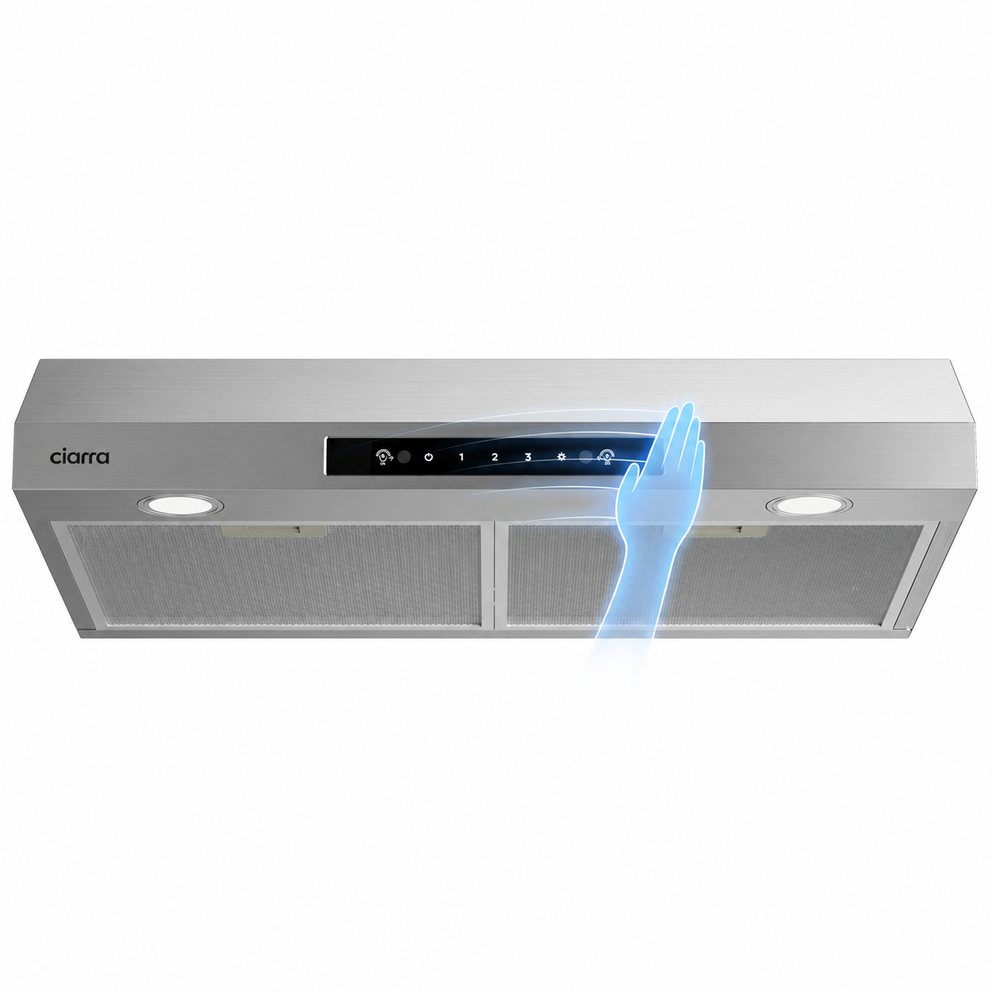


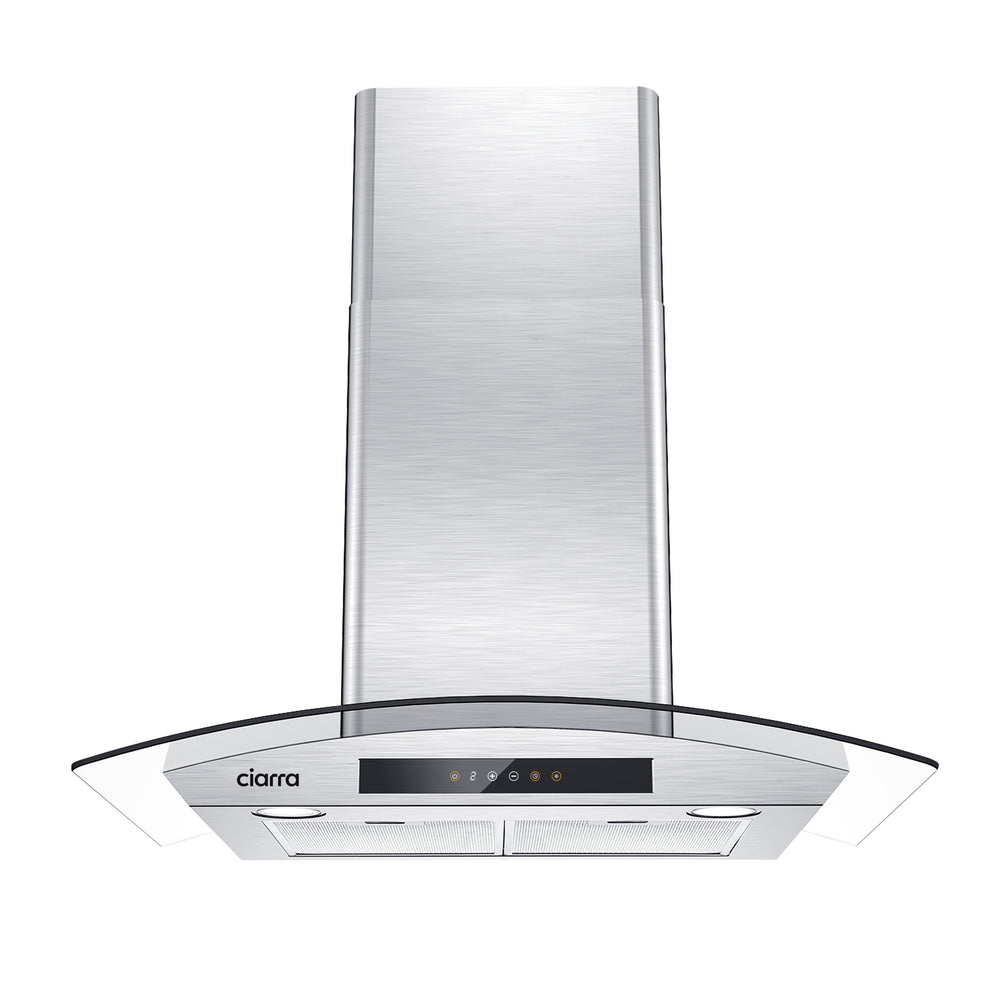

Ductless range hoods are highly effective at capturing airborne grease and eliminating cooking odors when properly maintained.
Which ductless range hood fits your kitchen?
Three questions, one answer:
1. How wide is your cooktop?
Your hood should be at least as wide as your cooktop — 20" and 24" for compact setups, 30" for standard ranges, 36" for wider pro-style cooktops. When in doubt, go one size up.
2. Where will it mount?
Under cabinet models slide beneath existing cabinetry; wall mount hoods become a design feature on an open wall; inserts disappear into custom cabinetry.
3. What do you cook on?
Electric and induction cooktops pair well with 200–300 CFM. A standard four-burner gas range calls for 300–400 CFM and fresh carbon filters on schedule.
Ductless vs. ducted: an honest comparison
| Feature | Ductless (recirculating) | Ducted (vented outside) |
|---|---|---|
| Exterior ductwork required | No | Yes |
| Typical install cost | $0–$200 (DIY-friendly) | $300–$800 with ductwork |
| Grease & smoke | Captured by metal filter | Vented outside |
| Cooking odors | Captured by carbon filter | Vented outside |
| Gas combustion gases (CO, NO₂) | Not removed — crack a window | Vented outside |
| Ongoing maintenance | Wash grease filter monthly; replace carbon filter every 3–6 months | Wash grease filter monthly |
| Best for | Apartments, condos, rentals, interior-wall kitchens | Homes with existing ducts, heavy high-heat cooking |
About CFM ratings: we list the manufacturer's rated maximum airflow. Independent laboratory measurements typically read lower; the rated figure is the right basis for comparing models within one brand.
How ductless filtration actually works
Every ductless hood cleans air in two stages:
- Stage 1 — Grease filter. A washable aluminum mesh or stainless baffle filter traps airborne grease before it can settle on your cabinets. Rinse it monthly or run it through the dishwasher.
- Stage 2 — Activated carbon filter. Air then passes through a charcoal filter that adsorbs odors and fine particles. This filter cannot be washed — replace it every 3–6 months (every 6–10 weeks if you fry or sear daily).
The cleaned air recirculates back into your kitchen. No duct, no wall penetration, no lost cabinet space.

Diagram: how a ductless range hood filters air through grease and activated carbon filters
Which carbon filter does your hood need?
Note: Carbon filters are not included and must be purchased separately, except for model CAS75938A (which includes the activated carbon cotton mesh in the box).
| Hood Model | Type | Width | Airflow | Noise (Sones/dB) | Carbon Filter | Included in Box? | Replace Every |
|---|---|---|---|---|---|---|---|
| CAS75206P | Wall Mount | 30" | 650 CFM | 3.6 sones | CACF003 | Sold separately | 3–6 months |
| CAS75308 | Wall Mount | 30" | 650 CFM | 3.6 sones | CACF003 | Sold separately | 3–6 months |
| CAS75502 / CAB75502 | Wall Mount | 30" | 646 CFM | 3.6 sones | CACF003 | Sold separately | 3–6 months |
| CAS60206P-N | Wall Mount | 24" | 400 CFM | 3.6 sones | CACF003 | Sold separately | 3–6 months |
| CAS52913E / CAB52913E | Insert | 20" | 530 CFM | 3.6 sones | CACF055 | Sold separately | 3–6 months |
| CAS75918A / CAB75918B | Insert | 30" | 200 CFM | 1.3 sones | CACF006 | Sold separately | 3–6 months |
| CAB90918B | Under Cabinet | 36" | 300 CFM | 1.3 sones | CACF006 | Sold separately | 3–6 months |
| CAS75938A | Under Cabinet | 30" | 400 CFM (295 actual) | ≤ 70 dB | Activated Carbon Cotton Mesh | Included in box | 3–6 months |
Add the matching filter to your cart and your hood is ductless-ready out of the box.
Ductless range hood FAQ
Q1. Do ductless range hoods really work?
Yes — for grease and odors. A ductless hood captures airborne grease in a metal filter and cooking odors in an activated carbon filter, then recirculates clean air back into the kitchen. What it does not remove is heat, steam, and (on gas ranges) combustion gases, so pair it with an open window during long, heavy cooking sessions.
Q2. What is the difference between ducted and ductless range hoods?
A ducted hood vents air outside through ductwork. A ductless (recirculating) hood filters the air and returns it to the room — no exterior vent required. Ducted removes heat and humidity; ductless removes grease and odors. If your kitchen has no path to an exterior wall or roof, ductless is the practical choice.
Q3. Can I use a ductless range hood with a gas stove?
Yes, ductless hoods are safe for use with gas cooktops. Keep in mind that carbon filters do not remove combustion gases such as CO and NO₂, so crack a window or run a secondary exhaust fan during extended gas cooking. Check your local building code and HOA rules if your jurisdiction requires outdoor venting for gas appliances.
Q4. How does a ductless range hood work?
A fan pulls cooking air through two filters: a washable grease filter first, then an activated carbon filter that adsorbs odors. The cleaned air exits through vents on the hood and recirculates into the kitchen — no ductwork involved.
Q5. What size ductless range hood do I need?
Match or exceed your cooktop width: 30" range → 30" or 36" hood. Compact 20" and 24" models suit small apartment cooktops. Mounting height matters too: 20–24 inches above electric cooktops, 24–30 inches above gas.
Q6. How many CFM do I need for a ductless range hood?
For electric or induction cooktops, 200–300 CFM covers everyday cooking. For a standard four-burner gas range, aim for 300–400 CFM. Higher CFM moves more air but adds noise — check the sones rating if you cook while entertaining.
Q7. How loud is a ductless range hood?
Loudness is measured in sones. Under 4 sones (about 56 dB) at mid-speed is comfortable for everyday use. CIARRA models list sones per fan level on each product page — lower is quieter.
Q8. How often should I replace the charcoal filter?
Every 3–6 months for average cooking. Daily frying or wok cooking can use up a filter in 6–10 weeks; light cooking can stretch one past 9 months. The grease filter is washable and only needs monthly cleaning.
Q9. Is the carbon filter included with the hood?
It depends on the model — check the compatibility table above. Models listing "sold separately" need one CACF003 or CACF006 filter kit added to your cart for ductless installation.
Q10. Can I install a ductless range hood myself?
Most customers do. Without ductwork, installation is mounting the hood to the wall or cabinet and plugging it in — typically under an hour with the included kit and manual. Hardwired models should be connected by a qualified electrician.
Q11. Will a ductless hood trigger my smoke alarm less often than no hood at all?
Yes, usually. Capturing grease and smoke at the source reduces how much reaches the alarm — one reason ductless hoods are popular in small apartments where the alarm sits close to the kitchen.
Q12. What warranty and return policy applies?
All CIARRA range hoods carry a 24-month warranty and a 30-day return window from delivery. If a ductless setup turns out to be the wrong fit for your kitchen, returns are straightforward.
Ductless Range Hood Installation Guides
Watch step-by-step installation tutorials for different mounting styles to set up your range hood easily.


