









When you see a 1,800-watt or 3,000-watt rating stamped on an induction cooktop, it’s completely natural to wonder: "Is this appliance going to drive up my monthly electric bill?"
The short answer is no, an induction cooktop does not use a lot of electricity in practice.
While induction cooktops rely on high peak wattage to heat cookware rapidly, high wattage does not equal high energy consumption. Because induction directly transfers electromagnetic energy to the iron in your cookware—achieving roughly 85% to 90% energy transfer efficiency—it cooks significantly faster and operates at peak power for only a fraction of your overall cooking time.
How Much Electricity Does an Induction Cooktop Use?
The simplest way to estimate electricity consumption is:
Electricity used = Power × Cooking time
Because electricity bills in the U.S. are generally based on kilowatt-hours (kWh), you first convert watts to kilowatts.
For an 1,800W induction cooktop:
- 1,800W = 1.8kW
- 10 minutes at 1.8kW = 0.3kWh
- 20 minutes at 1.8kW = 0.6kWh
- 30 minutes at 1.8kW = 0.9kWh
- 1 hour at 1.8kW = 1.8kWh
These numbers assume the cooktop is drawing the full 1,800W continuously. Real-world cooking can be different.
Once food or cookware reaches the desired temperature, the cooktop may not need to operate continuously at maximum power. The actual energy consumed during a meal can therefore be lower than a calculation based on maximum wattage.
This is why watts and kWh should not be treated as the same thing.
What Does Cooking a Meal Actually Cost?
Because electricity rates vary significantly by region, providing a single "average monthly cost" can be misleading. A far more accurate way to estimate your actual expense is with a simple formula:
Cooking Energy Cost = Kilowatt-Hours Used (kWh) ×Your Local Electricity Rate ($/kWh)
Boiling Water & Quick Meals (e.g., boiling 1.5 L / 6 cups of water, searing steak, or frying eggs):
Consumes roughly 0.15 to 0.25 kWh. At the average U.S. electricity rate of 16¢ per kWh, preparing a quick item or boiling a pot of water costs less than 4 cents in electricity.
Full Dinner Preparation (30–40 minutes using multi-zones):
Consumes approximately 0.6 to 1.0 kWh for a complete family meal (such as simmering a sauce on one burner while searing proteins or boiling sides on another). This brings the total energy cost to roughly 10 to 16 cents per dinner.

What Does 1,800 Watts Actually Mean?
The wattage on an induction cooktop tells you about its electrical power, not the total amount of electricity you will use during a meal.
A higher-wattage cooktop may heat cookware quickly, which can shorten cooking time. A lower-wattage cooktop may use less power at any given moment but could take longer to complete the same cooking task.
Therefore, saying "this cooktop is 1,800W, so it must be expensive to operate" is an incomplete calculation.
Does a High-Wattage Induction Cooktop Use More Electricity?
No, a high-wattage induction cooktop does not inherently use more electricity to complete the same cooking task.
While a higher wattage rating means the cooktop draws more power per second at peak capacity, total energy consumption—which appears on your electricity bill as kilowatt-hours (kWh)—depends on power multiplied by time.
Imagine two cooktops preparing the same pot of water.
One uses more power but heats the water quickly. Another uses less power but takes longer.
The total energy used depends on how much power each one actually consumes and for how long.
This is why comparing only the maximum wattage can give you the wrong impression about operating costs.
A high-wattage induction cooktop has the ability to use more power when operating at a high setting. However, that does not automatically mean it will consume more electricity for every meal.
Related: Are Higher Wattage Induction Cooktops Better
Is Induction Cheaper to Run than Electric?
Yes, induction can be cheaper to run than a traditional electric resistance cooktop, but the actual savings depend on your electricity rate, cooking habits, and the specific appliances.
Induction transfers heat directly to compatible cookware, which can reduce energy losses and heat food efficiently. It can also heat cookware quickly, potentially reducing cooking time.
For a fair comparison, compare the electricity consumed to perform the same task, such as boiling the same amount of water:
Running cost = kWh used × your electricity rate
Induction Cooktop vs. Electric Stove: Which Uses More Electricity?
Real-World Test: Boiling 1.5 Liters (6 Cups) of Water
To measure the actual energy efficiency difference, both appliances were tested under identical kitchen conditions: boiling 1.5 liters of room-temperature water (68°F / 20°C) in a standard stainless steel pot with a lid.
| Metric | Induction Cooktop (1,800W) | Radiant Electric Stove (1,800W) |
| Time to Boiling (212°F / 100°C) | 4 minutes 15 seconds | 9 minutes 30 seconds |
| Energy Consumed (kWh) | 0.13 kWh | 0.28 kWh |
| Estimated Cost (at $0.16/kWh U.S. Avg) | ~$0.02 | ~$0.04 |
| Thermal Efficiency | ~85%–90% | ~65%–70% |
Test Results & Conclusion
Even though both cooktops operated at a peak rating of 1,800 Watts, the traditional electric stove consumed over twice as much electricity (0.28 kWh vs. 0.13 kWh) to complete the exact same task.
Why the difference? Traditional electric coils must first heat up the element, then heat the glass top, and finally radiate that heat into the cookware—losing considerable energy to the surrounding air. Induction generates heat directly inside the base of the cookware, boiling the water in less than half the time and cutting energy consumption by approx. 50% per task.
For a deeper dive into how induction cooktops stack up against traditional electric stoves, check out our detailed guide on Induction vs. Electric Cooktops.
What Factors Affect Induction Cooktop Electricity Use?
What Factors Affect Induction Cooktop Electricity Use?
Several everyday factors can change how much electricity your induction cooktop uses.
1. Cooking Time
The longer the cooktop operates, the more electricity it can consume.
Reducing unnecessary cooking time can reduce energy consumption, but don't assume that using the lowest setting is always the most efficient approach. A very low setting that significantly extends cooking time may not reduce total energy use.
2. Power Setting
Higher settings generally allow the cooktop to deliver more power.
You may need a higher setting when bringing water to a boil, while a lower setting may be enough to maintain a simmer.
Using the appropriate setting for the cooking task is more useful than simply choosing the lowest possible setting.
3. Cookware
Induction cooktops require compatible cookware with a magnetic base.
Cast iron and many stainless-steel pans work with induction, while some aluminum, copper, glass, and ceramic cookware may not work unless they have an induction-compatible base.
Cookware size also matters. Using a pan that matches the cooking zone can help the cooktop transfer energy effectively.
4. Using a Lid
A lid can reduce heat loss when boiling or simmering food.
This may help food reach the desired temperature faster, although the actual energy savings depend on the cooking conditions.
5. Number of Cooking Zones
Using several cooking zones simultaneously can increase total electricity consumption.
However, the actual power available to each zone depends on the cooktop's design and power-management system.
6. Cooking Quantity
Heating a large pot of food requires more energy than heating a small quantity.
This is one reason why there is no single "average electricity cost per meal" that applies to everyone.
How to Save Electricity While Using Induction?
You don't necessarily need to avoid high-power cooking to keep energy use under control.
Instead, focus on using the cooktop efficiently.
1. Use the right-size pan. Choose cookware that matches the cooking zone where practical. A 6-inch heating zone works best with small pans measuring 5.5 to 7 inches across the base, making it ideal for boiling eggs or heating sauces. Standard 8-inch cooking zones perform most efficiently with medium 7- to 9-inch cookware, such as everyday skillets or medium saucepans. For large 10-inch or extra-large zones, pair them with 9- to 11-inch wide-bottomed pots, Dutch ovens, or heavy stockpots to prevent wasted electromagnetic energy.
2. Cover pots when appropriate. A lid can reduce heat loss during boiling and simmering.
3. Avoid unnecessary preheating. Don't leave an empty pan heating longer than needed.
4. Lower the power after reaching temperature. Once food reaches the desired temperature, a lower setting may be enough to maintain it.
5. Plan multiple cooking tasks efficiently. If you're using several zones, organize your cooking so that you don't unnecessarily extend the total cooking time.
Does Boost Mode Use More Electricity?
Boost mode is designed to provide higher heating power, so it can increase electricity use while it is active.
However, that does not mean Boost automatically makes a meal expensive to cook.
For example, you might use Boost for a short period to heat a pot quickly and then switch to a lower setting. The total electricity used depends on both the higher power and how long you use it.
Boost should therefore be evaluated based on the complete cooking task, not just its maximum power level.
It is also important to check your specific model because the way power is managed can vary between induction cooktops.
Does Using Two Induction Burners Double the Electricity Use?
Not necessarily. Operating two burners at the same time increases your immediate power draw, but it rarely doubles your total electricity consumption for several reasons:
1. Different Heat Settings: You rarely run two burners at max power simultaneously. While one burner might run at a high setting (e.g., 1,500W) to sear meat, the second burner is usually set to medium or low (e.g., 300W–600W) to cook a side dish or simmer a sauce.
2. Built-in Power Management: Most modern multi-zone induction cooktops feature automatic power-sharing limits. If both burners are turned on high, the system distributes power between them dynamically to prevent exceeding the cooktop's overall limit (typically capping total draw around 1,800W for portable dual units or 3,700W for built-in models).
3. Cooking Efficiency: Total electricity depends on the wattage used by each zone over the time each zone stays active, not simply adding up the peak capacity of every burner on the stove.
What's the Downside of an Induction Cooktop?
The main downsides of an induction cooktop are:
-
Requires compatible cookware: Pots and pans need a magnetic base, so some existing cookware may not work.
-
Higher upfront cost: Induction models can cost more than basic electric cooktops.
-
Electricity dependence: They won't work during a power outage unless you have backup power.
-
Cookware can make noise: Some pans may produce a low humming or buzzing sound, especially at higher settings.
-
Glass surface needs care: The smooth surface can scratch or crack if heavy cookware is dropped on it.
- Learning curve: Power levels can feel different from traditional gas or electric cooking, especially when adjusting to the fast response.
How Can You Measure Your Induction Cooktop's Real Electricity Use?
You can measure your induction cooktop's real electricity use with a plug-in energy monitor or electricity meter that shows kWh.
- Plug the induction cooktop into the energy monitor.
- Reset the monitor's reading to zero.
- Cook a typical meal using your normal settings.
- Record the total kWh used after cooking.
- Multiply the kWh by your electricity rate to estimate the cost.
For example, if the cooktop uses 0.7 kWh and your electricity rate is $0.20/kWh, the cooking session costs about $0.14.
For a more useful comparison, repeat the test with specific tasks such as boiling water, frying an egg, or simmering a sauce, while keeping the cookware, food quantity, and cooking conditions consistent.
CIARRA Induction Cooktops: Energy Efficiency, Power Control, and Key Features
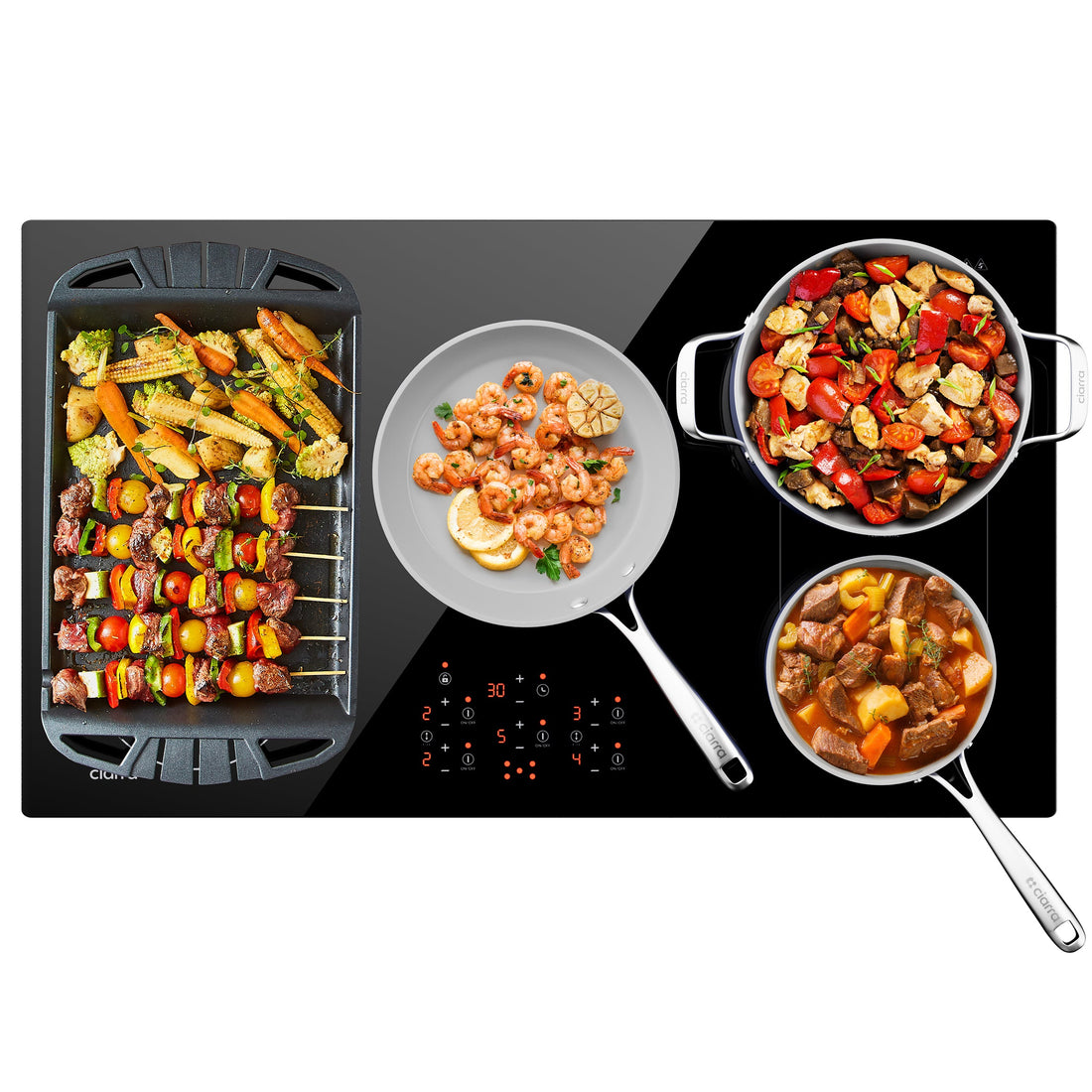
CIARRA 36-Inch 5-Burner Induction Cooktop
Designed for larger kitchens and multi-dish cooking, the CIARRA CABIH365BFF-OW combines precise power control with flexible cooking zones to help you manage heat and electricity use more effectively.
- 9 Power Levels: Adjust the heat more precisely instead of relying on maximum power for every cooking task.
- Power Boost for Faster Heating: Boost provides higher power for up to 5 minutes, helping bring water and cookware to temperature quickly.
- Direct Energy Transfer: Induction heating sends energy directly into compatible cookware, reducing heat loss around the pan.
- Individual Timers: Set up to 99-minute timers for each cooking zone to avoid leaving a burner running longer than necessary.
- Flexible Cooking Zones: Flexzone/Bridge Zone combines two cooking areas for larger cookware, allowing the available cooking surface to match the pan size.

- 5 Induction Zones: Supports multiple dishes at the same time, with up to 9,600W total power.
- Precise Touch Controls: Digital controls make it easy to adjust each cooking zone.
- Wide Cookware Compatibility: Works with magnetic cookware such as cast iron, enameled iron, and magnetic stainless steel.
- Built-In Safety Features: Includes child lock, residual heat indicators, automatic pan detection, automatic shut-off, overheat protection, and overflow protection.
- Large 11-Inch Central Zone: Designed for larger pans, with up to 3,700W Boost power.
- 240V/60Hz Built-In Design: Suitable for U.S. kitchens requiring a high-power built-in induction cooktop.
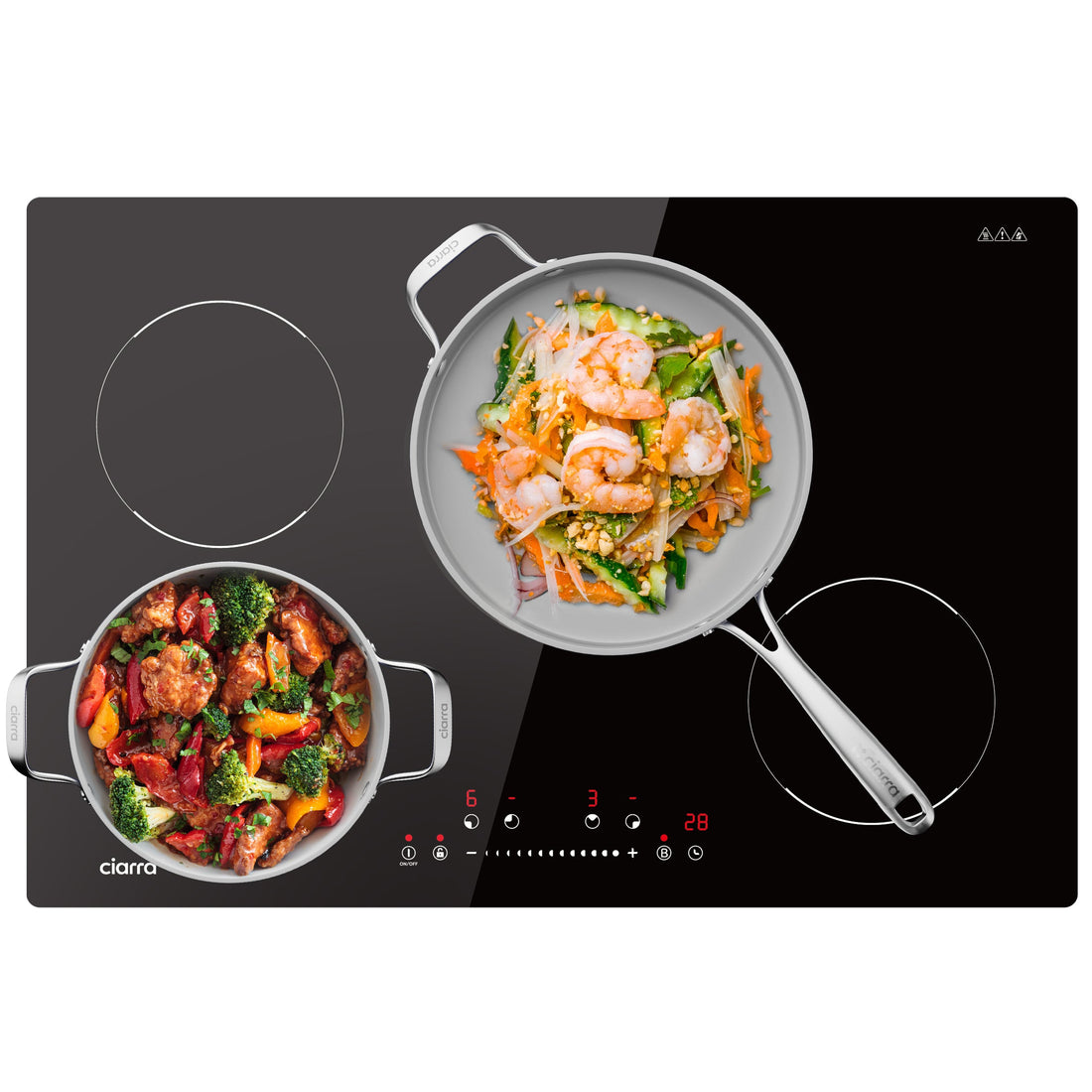
CIARRA 30-Inch 4-Burner Induction Cooktop
The CIARRA CABIH304B-OW offers a more compact built-in format while combining precise heat adjustment, fast heating, and features designed to help control cooking time and power use.
- 9 Power Levels: Gives you more control over cooking intensity, helping avoid using unnecessarily high heat.
- Direct Pan Heating: Induction technology transfers energy directly to compatible cookware, minimizing heat loss around the cooking surface.
- 5-Minute Power Boost: Provides extra power when you need to heat cookware or boil water faster, then allows you to return to a lower setting.
- 99-Minute Individual Timers: Timers help prevent unnecessary cooking time by automatically stopping a selected zone when the set time ends.
- Efficient Heat Adjustment: Slide-touch controls allow quick changes between higher and lower power levels for different cooking tasks.

- 4 Induction Zones: Provides space for everyday multi-pan cooking with up to 8,200W total power.
- 11-Inch Central Cooking Zone: Offers up to 3,700W Boost power for larger cookware.
- Slide Touch Controls: Provides intuitive control without physical knobs.
- Vitro-Ceramic Glass Surface: Provides a smooth built-in cooking surface that is easy to wipe clean.
- Built-In Safety Protection: Includes child lock, residual heat indicator, automatic pan detection, automatic shut-off, overheat protection, and overflow protection.
- Magnetic Cookware Compatibility: Designed for cast iron, enameled iron, and magnetic stainless-steel cookware.
- 240V/60Hz Built-In Design: Designed for U.S. built-in kitchen installations.
FAQs
How much does it cost to run an induction cooktop for one hour?
If an induction cooktop continuously draws 1.8kW for one hour, it would use 1.8kWh. Multiply that by your electricity rate to estimate the cost. For example, at $0.20 per kWh, 1.8kWh would cost $0.36.
Is induction cheaper than a regular electric stove?
It depends on the appliances, cooking task, usage habits, and electricity rate. Compare the kWh required to complete the same cooking task for a more meaningful comparison.
Is induction cheaper than gas?
It depends on local electricity and gas prices as well as the amount of energy each appliance uses. If you're switching from gas to induction, consider both the increase in electricity use and the decrease in gas use.
Does an induction cooktop use electricity when it is turned off?
Some models may consume a small amount of standby electricity while connected to power. The exact amount depends on the model, so check the manufacturer's specifications for accurate standby information.
What is the most accurate way to calculate my induction cooking cost?
Measure the actual kWh consumed during a typical cooking session and multiply that number by the electricity rate on your utility bill. This gives you a more personalized estimate than using a generic monthly cost.
Will switching to an induction cooktop raise my monthly electric bill?
No, switching to an induction cooktop will not cause a noticeable increase in your electric bill. In fact, because induction technology transfers 85% to 90% of its heat directly to your cookware—compared to just 65% for standard electric coil stoves and 40% for gas—it uses less total energy (kWh) to cook the same meal. Most households spend only $2 to $5 per month on electricity for daily induction cooking.
Why does my induction cooktop have a high wattage if it’s energy-efficient?
High wattage represents maximum heating potential, not continuous power consumption. A high-wattage burner allows you to reach cooking temperatures or boil water in half the time of a traditional stove. Because it completes the heating task so quickly and then dials down to lower maintenance power (300W–800W for simmering), the total kilowatt-hours (kWh) used per meal remains low.
Does leaving a pan on the cooktop waste electricity?
No. Induction cooktops generate heat through an electromagnetic field that only activates when a compatible iron-based pan is present and the heating zone is turned on. If you remove the pan or leave the stove on without active cooking, built-in sensors automatically pause or shut off power, preventing accidental energy waste.


